
The Open Shelf Desk
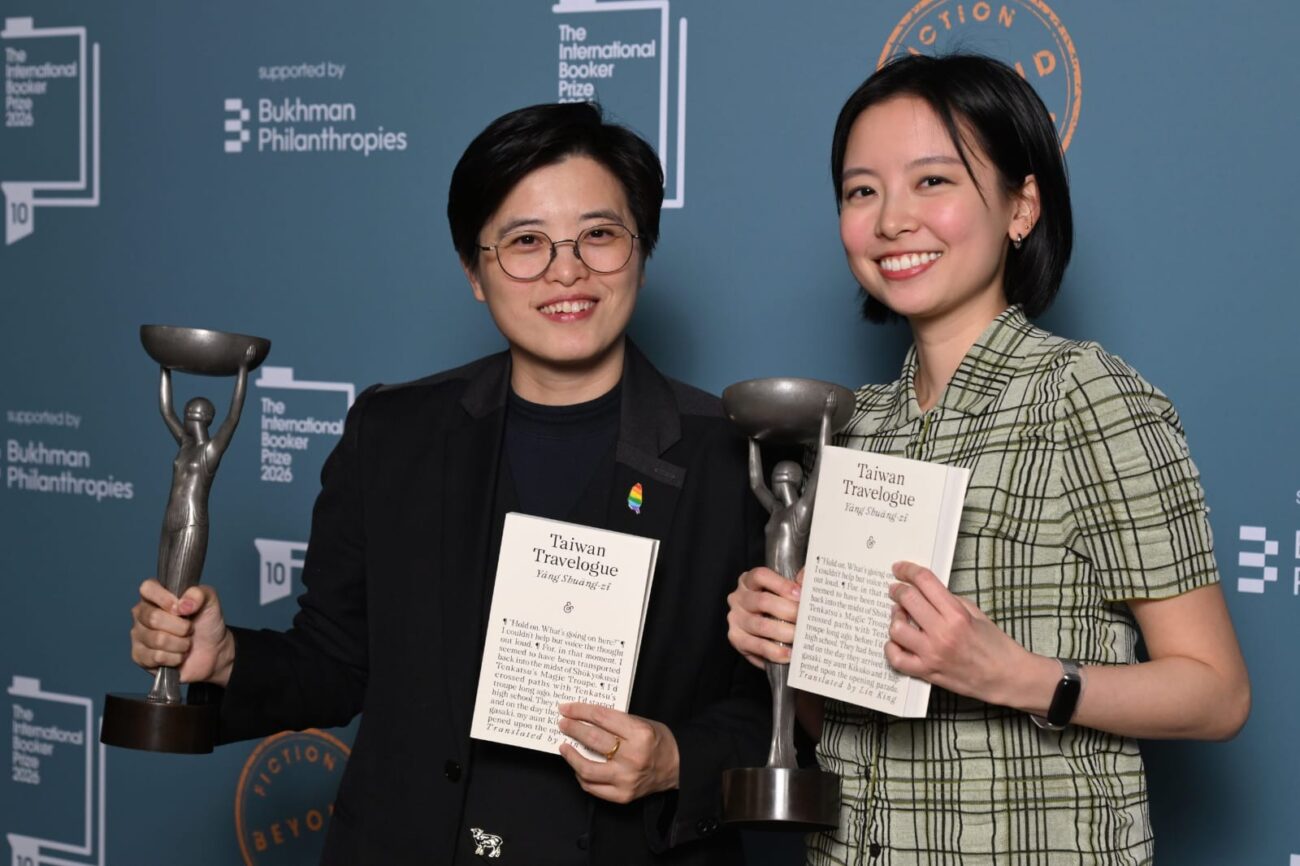
Something shifted in the literary world on May 19, 2026. At Tate Modern in London, Taiwanese author Yáng Shuāng-zǐ and Taiwanese-American translator Lin King walked away with the International Booker Prize for Taiwan Travelogue — the first novel originally written in Mandarin Chinese to ever win the award. It’s also the first win for a Taiwanese author and a Taiwanese-American translator.
If you haven’t read it yet, here’s the shape of it: The year is 1938. Taiwan is under Japanese colonial rule. A young Japanese novelist, Aoyama Chizuko, arrives on a government-sponsored tour hoping to eat her way through every Taiwanese specialty. She’s assigned a local interpreter, O Chizuru. What begins as a culinary travelogue becomes something slipperier — a love story, a power struggle, a question about who gets to speak and who gets to translate.
Judging chair Natasha Brown, the British novelist, called it a book that “pulls off an incredible double feat: It succeeds as both a romance and an incisive post-colonial novel”. That double-ness is the point. This isn’t just a forbidden love story between colonizer and colonized. It’s also a Matryoshka doll of a book — a fictional travel memoir layered with fake footnotes, afterwords, and real translator’s notes from Lin King. The structure itself asks: Can love overcome a power imbalance? Can translation?
Food as Archive, Language as Battleground
Each chapter in Taiwan Travelogue is named after a dish — bah-so, or braised minced pork; mitsumame, fruit and jelly ice. Food isn’t garnish here. It’s how the characters negotiate intimacy and distance. Yáng has said research for the novel “changed my life in two obvious ways: my savings went down; my weight went up”. You feel that appetite on the page. The “monstrous appetite” of the Japanese novelist becomes a metaphor for colonial consumption, but also for desire — the kind that makes you want to know someone by tasting what they taste.
But the book refuses to be only delicious. The translator isn’t just a cipher. She’s unknowable, resisting Aoyama’s attempts to decode her. King’s English translation adds another metafictional layer, with her own footnotes wrapping around the characters’ fictional ones. As Brown put it, this is “in some ways a love letter to translation”, though she insisted that wasn’t why it won. It won because it’s “a completely engrossing, completely delicious love story”.
Why This Win Matters Beyond the Prize
Before London, Taiwan Travelogue had already traveled far. Published in Mandarin in 2020, it won Taiwan’s Golden Tripod Award in 2021. King’s translation took the US National Book Award for Translated Literature in 2024. And now the Booker — £50,000 split equally between author and translator.
This is the second year running that Sheffield indie press And Other Stories has taken the International Booker. But the bigger story is linguistic. For decades, the prize — and global anglophone publishing — has been dominated by European languages. A Mandarin original breaking through signals a widening of the door. A Mandarin winner breaks decades of English-language dominance and could open more translation deals and streaming interest in Asian narratives.
Yáng isn’t just a novelist. She writes essays, manga, and video game scripts. Lin King, based in Taipei and New York, writes original fiction too — her debut novel Weeb is forthcoming. Their win isn’t a token gesture to “diversity.” It’s recognition that the most urgent stories right now are coming from the intersections: between languages, between genres, between empire and the people who had to survive it.
At The Open Selves, we talk a lot about identity as something porous, translated, never final. Taiwan Travelogue lives there. It’s queer romance, historical fiction, food writing, and postcolonial critique in one breath. It asks what happens when the person holding the notebook is also the person holding the power. And it answers with footnotes.
The book doesn’t resolve neatly. Colonizer and colonized don’t kiss and make up history. The interpreter remains partly out of reach. That’s the honesty Brown called “wryly sophisticated”. Love, in 1938 Taiwan, can’t fix the architecture of empire. But it can notice it. It can name the dishes. It can leave a record.
So read it for the romance. Read it for the politics. Read it for the way Lin King makes Mandarin wordplay sing in English. Taiwan Travelogue isn’t just the first Mandarin winner of the International Booker. It’s a reminder that literature travels — sometimes by boat, sometimes by appetite, always by translation.
Yáng Shuāng-zǐ and Lin King will split the £50,000 prize. The novel was published in English in March 2026.
